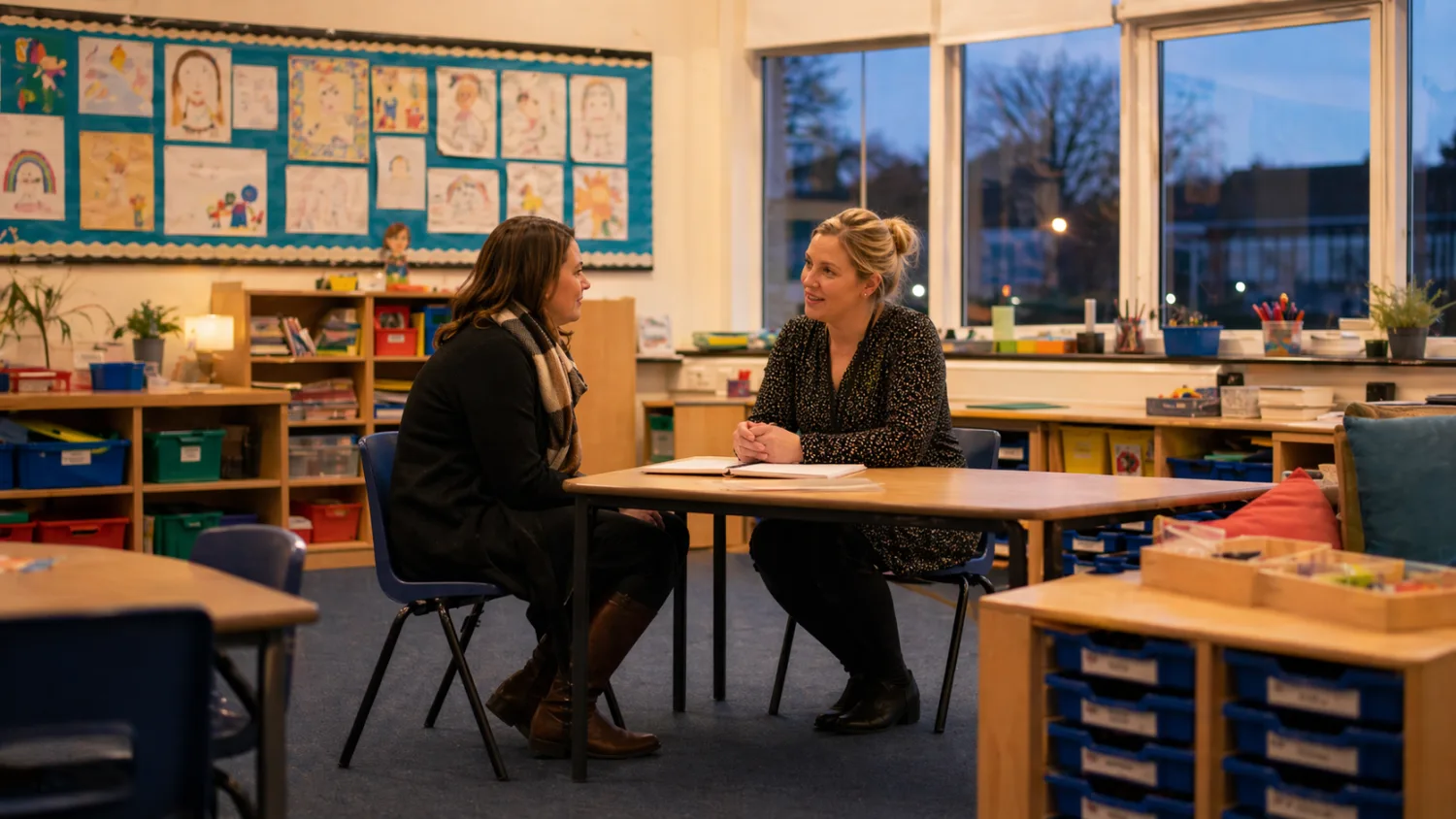

Parents’ evening can feel like a small appointment on the calendar, but for many families it carries far more weight than the timeslot suggests. It is often the one point in the term when you get face-to-face time with your child’s teacher, hear how things are really going in the classroom, and try to make sense of progress, behaviour, effort, friendships and next steps in a very short conversation.
That is why so many parents come away from parents’ evening feeling one of two things: either relieved that things are broadly fine, or frustrated that they forgot to ask half of what mattered to them. Sometimes both.
The good news is that a little preparation makes a huge difference. You do not need a folder full of notes, a long list of complaints or a rehearsed speech. But it helps to arrive knowing what you want to understand, what your child may need support with, and how to make the most of a brief meeting without letting it become tense, defensive or rushed.
This guide will help you prepare for parents’ evening in a way that is calm, useful and realistic. The aim is not to “perform” as a perfect parent. It is to leave with a clearer picture of how your child is doing at school and what, if anything, needs to happen next.
If you are also trying to make sense of written feedback from school, our guides to school reports and grades, understanding the UK curriculum and key stages and UK school terms and education jargon may help alongside this one.
What parents’ evening is really for
At its best, parents’ evening is not just a progress update. It is a chance to connect the two worlds your child lives in every day: home and school. Teachers see one version of your child. You see another. When those perspectives come together well, you get a more complete and more useful picture.
Parents’ evening is usually not the place for a full deep dive into every issue, nor is it always the right setting for resolving serious concerns in detail. Time is limited, and teachers are often moving from one family to the next with only a few minutes per conversation. But it is the right time to understand how your child is settling, learning, coping and presenting in school, and to notice where home and school perceptions match or differ.
That matters because many children are different in different settings. Some seem confident at home and quiet at school. Some appear relaxed in class but come home emotionally exhausted. Some are academically capable but disorganised, anxious or disengaged. Others are trying hard but masking how much they are struggling. A good parents’ evening helps bring some of that into focus.
Why it helps to prepare in advance
It is very easy to assume you will just “see how the conversation goes” and ask questions in the moment. Sometimes that works. More often, parents walk away and immediately remember the one thing they really needed to ask. Or they leave with general comments such as “doing fine” or “needs to focus a bit more” but no real sense of what those phrases mean in practice.
Preparation helps you use the time well. It also helps you stay balanced. If you are nervous, emotional, worried or already frustrated about something, a bit of thought beforehand can stop the meeting becoming reactive. Instead of trying to think on the spot, you go in with a clearer sense of what you need to understand.
That preparation does not need to be elaborate. A few notes on your phone or a short list in your head is often enough. The important thing is to avoid turning up cold and hoping the most important questions will somehow surface by themselves.
Start with what you already know
Before parents’ evening, take stock of what you already know about how things are going. This sounds obvious, but parents often skip it. They go straight into “What should I ask?” without first looking at the clues already in front of them.
Think about what your child says about school, even if it comes in fragments. Do they mention enjoying lessons, friends, playtimes, clubs or certain teachers? Do they seem reluctant to talk, unusually tired, anxious, withdrawn or quick to say school is “fine” and shut the subject down? Have you noticed changes in confidence, motivation, behaviour or willingness to do homework?
Also look back at any recent reports, assessment updates, exercise books, emails or school messages if you have them. You do not need to arrive armed with evidence, but it helps to notice patterns. If your child’s report suggested they were doing well in reading but struggling more in writing, or if homework has become a repeated point of stress, those are useful things to bring into the conversation.
If you want help decoding school language before the meeting, our guide to what school reports and grades really mean can help translate some of the wording that often appears in feedback.
Talk to your child before the meeting
One of the simplest and most useful things you can do before parents’ evening is ask your child how school feels to them at the moment. Not in an interrogating way, and not as a dramatic “Tell me everything before I see your teacher” moment. Just calmly and casually.
You might ask what they enjoy most at school right now, whether anything feels hard, whether there is anything they wish teachers noticed more, or whether there is anything they want you to ask. Older children, especially, often appreciate being included in this. It helps them see parents’ evening as a conversation about supporting them, not a secret meeting being held behind their back.
Younger children may not offer much detail, and that is normal. Even so, their tone, hesitations and throwaway comments can be revealing. A child who says “I don’t like writing because everyone else is faster,” or “I never get picked,” or “Playtime is too noisy,” is giving you useful starting points, even if they do not expand on them.
Try not to promise that you will raise every grievance exactly as your child describes it. Sometimes what they report is partial or emotionally coloured. But listening beforehand can help you go into the meeting with better questions.
Know what matters most to you
Parents’ evenings are often short, and different issues can compete for attention. So before you go, decide what matters most. What do you most want to understand by the end of the conversation?
For some parents, that may be academic progress. Is my child where they should be? Are they keeping up in reading, maths, writing or key subjects? Are they coasting, struggling or making steady progress?
For others, the bigger concern may be confidence, friendships, behaviour, focus, wellbeing or how settled the child feels day to day. A child can be achieving well on paper while quietly finding school emotionally hard. Equally, a child who seems happy socially may need more support in learning than you realised.
If everything feels important, narrow it down to two or three priorities. Parents’ evening works best when you leave with clarity on the things that matter most now, rather than trying to squeeze every possible issue into ten minutes.
The most helpful questions to ask
There is no single perfect script for parents’ evening, but the best questions are usually open enough to invite real insight rather than yes-or-no answers. Instead of asking only whether your child is “doing well”, try to understand how the teacher sees them in the day-to-day life of the classroom.
Useful questions often include things like:
- How is my child getting on overall in class?
- What are they doing well right now?
- What would help them make the most progress over the next few months?
- How confident do they seem in lessons?
- How do they behave and engage during the school day?
- Are there any concerns around focus, organisation or effort?
- How are they getting on socially with other children?
- Is there anything you think we should support more at home?
Those questions open up a fuller discussion than “Are they okay?” They also give teachers room to talk about strengths as well as concerns, which matters. Parents’ evening should not only be about spotting problems. It should also help you understand what is going well and what your child is building on.
Questions that go beyond attainment
It is very natural for parents to focus first on levels, grades, scores or whether a child is “on track”. But some of the most valuable information you can get at parents’ evening has little to do with raw attainment. In many cases, the more useful question is not just “How are they achieving?” but “How are they experiencing school?”
You may want to understand whether your child contributes in class or stays quiet, whether they ask for help when needed, whether they seem resilient after mistakes, whether they mix with others confidently, or whether they appear anxious, distracted or overwhelmed in certain parts of the day.
This kind of information can be especially important if your child tends to mask emotions, keep worries to themselves or say very little about school at home. It can also be revealing if the school view is very different from what you expected. Sometimes that is reassuring. Sometimes it highlights an area that needs a closer look.
If your child is doing well, still ask for specifics
One of the easiest traps at parents’ evening is to relax too quickly when the overall message sounds positive. If the teacher says your child is doing well, is settled and making progress, that is lovely to hear. But it is still worth asking what that means in practical terms.
What are they particularly strong in? Where are they growing in confidence? What would stretch them further? Are they contributing, leading, reading deeply, asking good questions, taking care with work, helping others? General praise is nice, but specific feedback is more useful. It gives you a clearer sense of your child as a learner, not just a broad impression that all is fine.
It can also help you encourage them more meaningfully at home. “Your teacher said you explain your ideas clearly in class” is more powerful than “Teacher says you’re doing fine.”
If you already have concerns, bring them calmly
Some parents arrive at parents’ evening already worried. Perhaps homework has become a battle. Perhaps your child cries before school, complains of stomach aches, says they have no friends, or insists they hate a subject they used to enjoy. Perhaps you suspect they are struggling more than school has recognised.
It is completely reasonable to raise concerns at parents’ evening. In fact, it is often the right place to start. But it helps to frame concerns clearly and calmly. Instead of launching with “Nothing seems right and nobody has noticed,” try something closer to “We’ve noticed that mornings have become much harder lately,” or “My child is saying they feel lost in maths and I wanted to understand how that looks in class.”
This invites collaboration rather than confrontation. Teachers are much more likely to respond constructively when concerns are expressed in a way that is specific and grounded. That does not mean minimising serious problems. It simply means starting from evidence and observation rather than accusation.
If the issue is more significant than can be handled in a brief slot, parents’ evening can still be useful because it becomes the moment where you identify that a separate conversation is needed. Not every problem should be solved in the corridor queue between other appointments.
How to handle a short appointment well
One of the hardest parts of parents’ evening is the time pressure. Even a very thoughtful teacher can only say so much in a short meeting, especially when dozens of other families are waiting. That is why it helps to be direct without being abrupt.
Start with your main question early rather than spending most of the slot on preliminaries. Listen carefully to the answer. If the teacher says something broad, ask a gentle follow-up that brings it into focus. If they mention progress, ask what is driving it. If they mention concern, ask what that looks like in class and what support would be most useful. If they say your child is quiet, ask whether that seems like confidence, personality or uncertainty.
In other words, use the short time to get from vague impressions to practical understanding.
It can also help to jot down a few words immediately afterwards, especially if you have appointments with more than one teacher. Parents often assume they will remember everything and then discover later that several conversations blur into one.
What not to do at parents’ evening
Most parents go in with good intentions, but a few common habits make parents’ evening less useful than it could be. One is arriving with no clear focus and hoping the teacher will somehow cover everything. Another is turning the meeting into a detailed defence of your child against every criticism before fully hearing what is being said.
It also helps to avoid comparisons with other children. Even if you strongly suspect that your child’s friendship group, seating plan or social dynamic is part of the issue, teachers cannot discuss another child’s behaviour or progress in detail with you. Keeping the focus on your own child makes the conversation more productive.
Another trap is asking only about attainment when the bigger issue is confidence, wellbeing or engagement. If your child seems unhappy or under strain, do not let the conversation end with “They’re on track academically” as though that answers everything.
And if you are upset, frustrated or anxious, try not to let the meeting become a release valve for months of emotion. That is understandable, but it often leaves everyone with less clarity, not more.
If the feedback surprises you
Sometimes parents’ evening brings a surprise. You may hear that your child is thriving when you were worried. Or you may hear that they are disengaged, distracting others, rushing work or lacking confidence when none of that has been obvious at home.
If that happens, pause before reacting too strongly. Surprise does not automatically mean the teacher is wrong, and it does not automatically mean your child has been hiding something in a worrying way. Children are different in different environments. School places demands on them that home does not, and vice versa.
Try to get specific. Ask for examples. Ask when the teacher notices the pattern most. Ask whether it seems new or longstanding. Ask what support is already in place or what the next step might be. Useful parents’ evening conversations are often the ones where you move beyond “That doesn’t sound like my child” into “Help me understand when and how this is showing up.”
How to ask about friendship or social concerns
For many parents, social wellbeing is just as important as academic progress, especially in primary school and the early years of secondary. If your child is unhappy about friends, isolated at breaktime, falling out with peers or finding the social side of school exhausting, parents’ evening can be a good moment to ask how things look from the school’s point of view.
You do not need to dramatise it, but it is worth asking directly if you have concerns. Teachers may not always see everything, particularly if issues happen outside the classroom, but they can often give valuable context. Sometimes they will reassure you that your child is mixing more than they realise. Sometimes they may confirm that they have noticed difficulties too.
If friendships, confidence or belonging are a worry, you may also find some overlap with our guide on helping shy children build confidence at school.
How to ask about behaviour without shame or defensiveness
If behaviour is part of the conversation, try to keep the focus on understanding rather than blame. The most useful question is rarely “Were they naughty?” but “What situations seem hardest for them, and what helps?”
Behaviour feedback can be hard to hear because parents often experience it as a judgement on the child or on themselves. But behaviour is usually more informative when looked at in context. Is your child impulsive? Distracted? Struggling with transitions? Tuning out when work feels hard? Being silly to gain attention? Overwhelmed by noise or change? The answer matters because different causes need different responses.
Teachers are often able to tell you whether the issue seems occasional, developmental, situational or part of a broader pattern. That is much more useful than reducing everything to “good” or “bad” behaviour.
If your child has additional needs or you suspect they may
Parents’ evening can be especially important if your child already has additional needs, receives SEND support, is awaiting assessment, or you are beginning to wonder whether something more may be going on. Sometimes teachers’ observations help confirm a pattern. Sometimes they highlight strengths as well as needs. Sometimes they show that your child is coping better in school than you feared. Sometimes they raise questions worth pursuing further.
If this applies to your family, it can help to ask not just how your child is doing overall, but what support seems to help most, what situations are hardest, whether school has noticed similar patterns to home, and whether a further conversation would be useful. Parents’ evening may not be the right format for a full SEND discussion, but it can be a useful gateway into one.
You may also find our guide to SEN support and EHCPs for parents helpful if you are trying to understand the wider picture.
Should you bring your child?
This depends on the school, the age of the child and the style of the meeting. Some schools expect parents to attend alone. Others include the child, especially in secondary settings or student-led formats. If your child is attending, it can be a positive experience, but it does slightly change the dynamic.
When children are present, it becomes even more important to keep the conversation constructive. Praise should be specific and genuine. Concerns should be discussed in a way that is honest but not humiliating. A child should not leave feeling publicly dissected in front of them. If there are bigger worries to discuss, it may be better to request a separate conversation rather than trying to handle everything there and then.
If your child is not attending, you can still involve them afterwards by sharing the main positives and the next steps in a supportive way.
How to talk to your child after parents’ evening
What happens after parents’ evening matters almost as much as the meeting itself. Children are often curious, even when they pretend not to be. They want to know what was said and whether they are in trouble. The way you feed back can either build confidence or increase pressure.
Start with the positives, and make them concrete. If the teacher said your child contributes thoughtful ideas, has improved in reading, shows kindness, works hard in practical lessons or has settled well socially, say so. Children should hear the strengths that adults notice in them.
If there are areas to improve, keep the tone steady and practical. Instead of “Your teacher says you need to try harder,” it is usually more helpful to say something like, “Your teacher thinks you’re capable of more in maths when you slow down and check your work,” or “They think getting started more quickly would help you feel less rushed.”
The aim is to give your child a sense that feedback is there to help them grow, not to label them as a problem.
When parents’ evening is not enough
Sometimes parents’ evening does exactly what it should: it reassures, clarifies and gives you useful next steps. But sometimes it reveals that the issue is bigger, more complex or more urgent than a short appointment can handle. If that happens, it is completely appropriate to ask for a follow-up conversation.
This might be needed if there are concerns about bullying, persistent anxiety, falling behind significantly, attendance, behaviour, additional needs, safeguarding or a serious mismatch between home and school views. Parents’ evening can open the door, but it does not have to carry the whole weight of the issue.
If you are trying to work out how and when to raise a concern more formally, our guide on when to raise a concern and when to make a formal complaint may help distinguish between informal conversations and more structured next steps.
A simple way to prepare the day before
If your parents’ evening is tomorrow and you have not prepared at all, do not worry. You do not need hours. Ten minutes is enough to make the meeting much more useful.
Take a moment to note:
- the one or two things you most want to understand
- any concern your child has mentioned recently
- any practical issue at home that may affect school
- one question about progress and one question about wellbeing
That alone will help you go in more focused than most people do.
Final thoughts
Parents’ evening works best when you treat it neither as a judgement day nor as a formality to get through, but as a useful checkpoint. It is a chance to understand your child more fully, hear how school sees them, and notice where support, encouragement or follow-up might help most.
You do not need to ask dozens of questions. You do not need to prove anything. You do not need to leave with every issue solved. What matters is that you come away with a clearer sense of how your child is doing, what is going well, and what the most useful next step might be.
And if the meeting raises more questions than it answers, that in itself can still be valuable. Sometimes the most important outcome of parents’ evening is simply recognising what deserves a longer conversation.
If you are building a fuller picture of your child’s school experience, you may also find it helpful to read our guides on school reports and grades, how schools handle safeguarding and school concerns and complaints.